
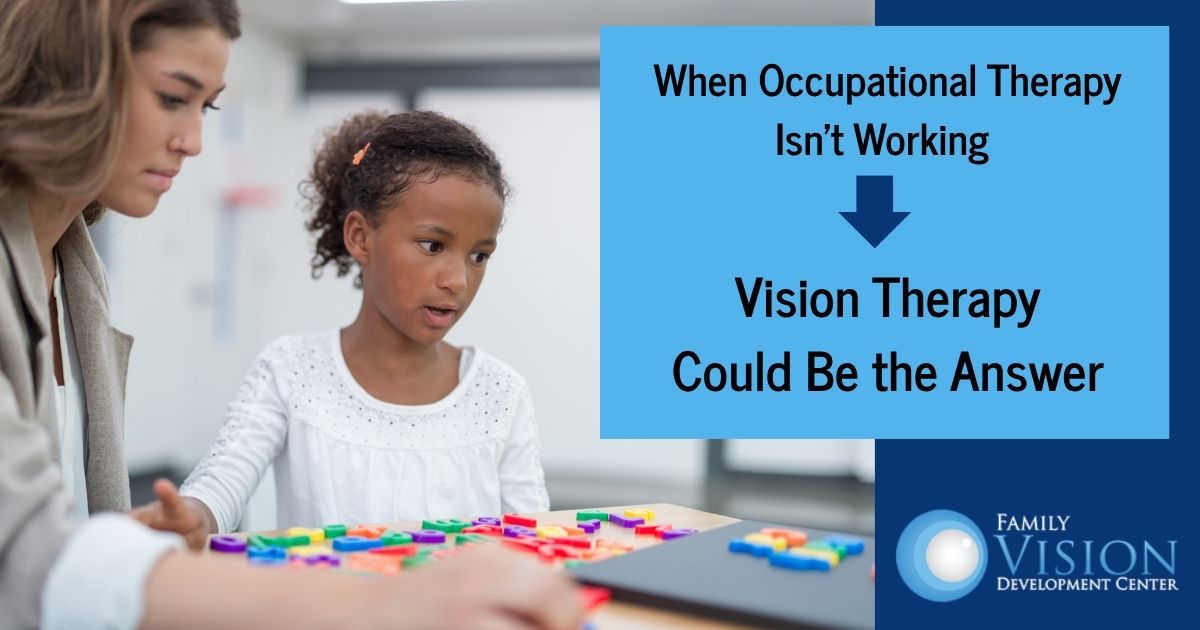
An occupational therapist can play an important role in helping a child build the skills they need to succeed in daily life. They work with kids to develop essential skills like handwriting, proper coordination, attention and taking care of themselves. But if a child is still struggling, even after consistent therapy, there might be another issue interfering – their visual skills.
Vision is more than just seeing clearly. It is actually a complex system that involves the eyes working together as a team and the brain properly processing the visual information it receives. When these systems are not functioning correctly, children may have trouble performing tasks that seem unrelated to eyesight. That’s where a tailored vision therapy program can make a significant difference.
Understanding the Signs of Visual Dysfunction
Children don’t always understand that a vision issue is present, so they don’t know how to communicate what the problem is. Instead, they often simply adapt to their circumstances and they end up compensating in ways that further complicate their developmental progress. When an occupational therapist works with a child over a period of time, they are able to observe certain patterns and signs that vision therapy could be necessary. Some common signs that may indicate a need for a vision therapy evaluation include:
- Poor eye-hand coordination, such as difficulty catching a ball, completing puzzles, or using utensils
- Avoiding close-up tasks like coloring, reading, or writing
- Frequently losing their place when reading or copying from a board
- Reversing letters or numbers
- Excessive head movement or closing one eye when focusing
- Short attention span during tasks that require visual concentration
- Frequent headaches, eye strain, or fatigue
- Difficulty with coordinating both sides of the body
These challenges may be the result of issues like poor eye teaming (binocular vision), inaccurate eye movements (tracking), or difficulty focusing (accommodation).
How Vision Therapy Supports the Goals of an Occupational Therapist
When a child’s visual skills are not developed properly, they may not be able to fully benefit from working with their occupational therapist. For example, a child’s difficulty with their handwriting sessions might not be due to a weakness in fine motor skills. Instead, it could be because their eyes cannot efficiently track across a page or maintain focus.
Vision therapy is a personalized program designed to improve visual function and processing. It targets skills such as:
- Eye teaming and alignment
- Tracking and visual scanning
- Focusing flexibility
- Visual memory and processing speed
By addressing these foundational skills, vision therapy can make it easier for a child to participate in OT and make more consistent progress.
Collaboration Leads to Better Outcomes
Occupational therapists and optometrists share a common goal – helping children succeed in their daily environments. When these providers work together with a unified treatment plan, children benefit from a more comprehensive, whole-child approach.
The team at Family Vision Development Center has extensive training and experience in vision therapy treatment. We work with each child to create an individualized plan that targets their specific visual challenges, so they get the most benefit from their work with their occupational therapist. The earlier we can identify issues and get to work with the right therapy, the quicker we can help prevent a child’s frustration, improve their confidence and support their long-term success, both in and out of therapy. Contact us at 630-862-2020 to learn more.
Family Vision Development Center is a full-service vision center offering innovative vision therapy services, sports vision therapy services, post-concussive vision rehabilitation, comprehensive vision exams for eyeglasses and contact lenses, management of ocular diseases including glaucoma, diabetes, macular degeneration and cataracts, and a state-of-the-art optical center offering the latest designs in eyewear.