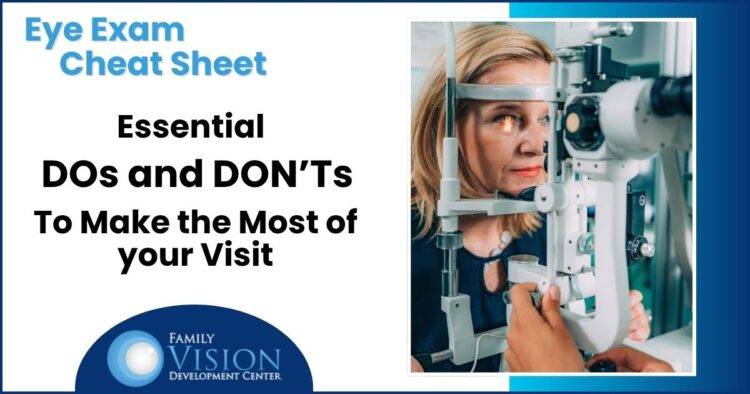
Preparing for an eye exam does not have to be difficult or complicated. But, it is an important way to get the most out of your visit. A comprehensive vision exam includes much more than just determining if you need glasses or a new prescription. The exam provides us the opportunity to get a complete evaluation on your vision, eye health, focusing ability and how well your eyes work together.
Through a series of tests, we are able to detect both obvious and underlying issues and suggest the appropriate options for correcting any visual concerns. The more complete information we have, the more accurate results we can obtain. That’s why preparing for an eye exam ahead of time matters. Here’s what you should do before you arrive for your appointment.
DO Bring your Current Insurance Information
We want to make sure as many people as possible are able to receive the vision care they need, and that’s why we work many vision insurance providers. Bringing your most up-to-date information allows us to properly submit your claim. If you do not have insurance, we can still work with you! Be sure to contact us before your appointment to determine the best alternative payment options to help with your care.
DO Gather Complete Medical History
Part of properly preparing for an eye exam includes gathering vital medical information, including a list of current medications, and as complete of a family medical history as possible. This information gives us a clearer picture of possible prescription side effects, increased risk factors for certain conditions, and helps us more accurately interpret test results.
DON’T Forget to Bring your Current Glasses or Contact Lenses
Before coming to the office, gather all of the glasses you wear, including reading glasses, prescription sunglasses, computer glasses, etc. We want to see what lenses you currently have, how they are working, what needs improvement, as well as compare the new prescription to the old one. If you wear contacts, don’t wear them to the appointment, but do bring the box with so we can note the brand, lens type, power, base curve, and diameter if possible. This information helps us evaluate your current fit and discuss whether another option may better suit your comfort or vision needs.
DO Make a List of Questions and Visual Concerns
Sitting in a medical office can be an intimidating experience. We try to make the environment here as relaxing and welcoming as possible, but we know that trying to focus on participating in the exam can make you forget important questions you wanted to ask. When preparing for an eye exam, write down any questions you may have about your eye health, benefits of vision therapy programs for school or sports, or even suggestions for a different shape frame for your glasses. If you have experienced any concerning symptoms like frequent headaches, difficulty focusing, light sensitivity, floaters or flashes or balance issues, be sure to let us know during your appointment.
DON’T Squeeze the Appointment into a Packed Day
We understand that schedules get very busy, and we appreciate that you are making time for your eye health. However, if possible, try to schedule your appointment during a time when you are not feeling especially rushed or preoccupied with other impending tasks for the day. Allow yourself the chance to take your time when answering questions and participating in the evaluation, as well as asking any follow-up questions. Also, if your eyes are dilated for the exam, this can increase light sensitivity which can make driving to additional appointments more difficult.
Preparing For an Eye Exam is Important for the Best Experience
At Family Vision Development Center, we want to make sure all of our patients receive the best possible care at every visit. Whether it’s your first time here or your tenth, properly preparing ahead of time can make a world of difference in your overall experience. Contact us at 630-862-2020 with any additional questions or to get your appointment scheduled as soon as possible.
Family Vision Development Center is a full-service vision center offering innovative vision therapy services, sports vision therapy services, post-concussive vision rehabilitation, comprehensive vision exams for eyeglasses and contact lenses, management of ocular diseases including glaucoma, diabetes, macular degeneration and cataracts, and a state-of-the-art optical center offering the latest designs in eyewear.
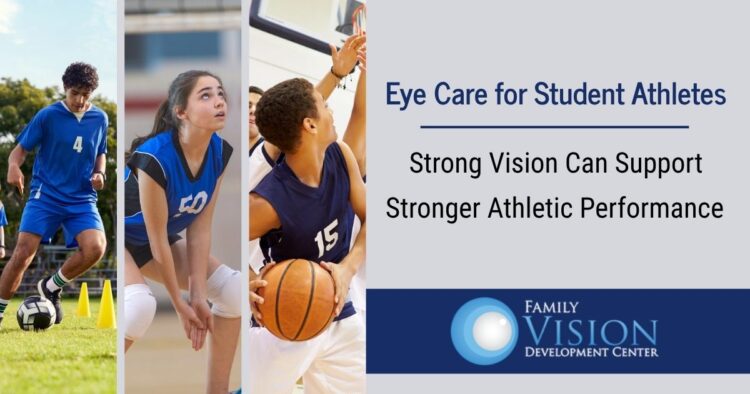
For student athletes, proper visual skills are essential to be able to play safely and perform at their best. Athletes rely on their eyes to track moving objects, judge distance, react quickly, maintain balance, and coordinate their movements. But, as important as it is, proper eye care can get overlooked when the busy season starts. Here are some important suggestions to keep in mind to maintain healthy vision and strong performance.
Schedule Regular Eye Exams
This tip actually applies to everybody, but student athletes should pay particular attention. Because athletes rely so heavily on their visual skills, a comprehensive eye exam is the easiest way to monitor any changes in vision and take action quickly in order to correct any issues. Even if the scoreboard looks clear, a vision exam can detect underlying issues that are not as obvious, such as depth perception, tracking or eye coordination.
Wear Protective Eyewear
Getting hit in the eye with an 80mph fastball is not only painful, but it can lead to a scratched cornea, bleeding inside the eye, a fractured eye socket, retinal damage, permanent vision loss, or even loss of the eye itself. Student athletes face these risks in baseball, softball, basketball, racquet sports, hockey, lacrosse, and other activities where balls, equipment, elbows, or collisions can happen without warning. Protective sports eyewear made with impact-resistant polycarbonate lenses helps shield the eyes from direct blows and flying objects while allowing students to see clearly and play confidently.
Make Sure Eyes Get Needed Breaks
Between practice time, homework and daily use of personal digital devices, student athletes may experience extra stress on their vision which can result in tired or uncomfortable eyes. Fortunately, there are easy ways to combat this. For example, taking short breaks after focusing on screens or close-up work, occasionally looking at an object in the distance in order to relax focusing muscles, using adequate lighting, staying hydrated and getting enough sleep can all help to give your eyes the rest they need to stay healthy.
Don’t Ignore Vision Changes
Blurred vision, headaches, eye strain, double vision, dizziness, difficulty focusing, or trouble tracking objects shouldn’t simply be blamed on a long practice or a busy school schedule. These symptoms can sometimes indicate an underlying vision problem. If something about your vision doesn’t feel right, call us to schedule an exam so we can help determine what may be causing it.
Student Athletes Should Explore Vision Therapy for Performance
Competition for the top spot on the team, or even a college offer, can be fierce, so any added advantage can make a significant impact to student athletes. Vision therapy is an effective way to sharpen the visual skills needed for better performance on the court or field. This personalized program uses structured activities to retrain the way the eyes and brain work together. It can help improve skills like eye tracking, focusing, depth perception, peripheral awareness, visual processing, and eye-hand coordination. These essential skills are used to follow a moving ball or opponent, quickly shift focus between near and distance, coordinate eye and body movements and efficiently respond to what is happening in the game.
Family Vision Development Center Helps Athletes Succeed
Healthy vision is the base of strong athletic performance, as well as an advantage in daily activities like reading, writing and driving. At Family Vision Development Center, we care for our student athletes by providing comprehensive vision exams that allow us to monitor and quickly detect and treat vision issues that can impact both athletic and school success. In addition, we have advanced training in vision therapy techniques that can strengthen visual skills and vastly improve game performance. Reach out to our Aurora office by calling 630-862-2020 to learn more and to schedule an appointment for an exam.
Family Vision Development Center is a full-service vision center offering innovative vision therapy services, sports vision therapy services, post-concussive vision rehabilitation, comprehensive vision exams for eyeglasses and contact lenses, management of ocular diseases including glaucoma, diabetes, macular degeneration and cataracts, and a state-of-the-art optical center offering the latest designs in eyewear.
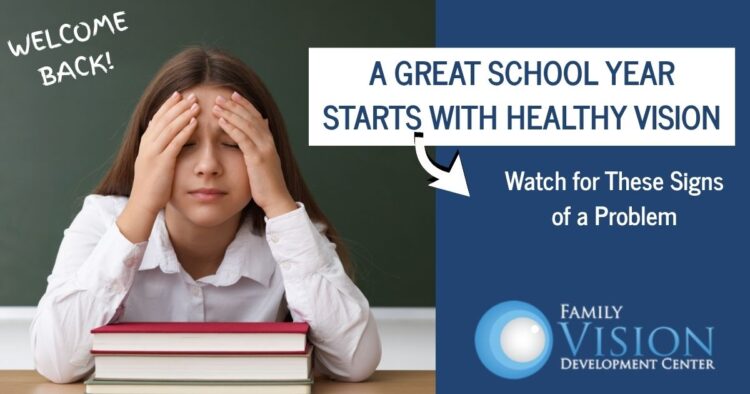
As the new school year resumes, it brings the opportunity for students to tackle new challenges and set fresh goals to work toward. When a student starts the year with high hopes and ambition, it can be extremely discouraging if vision issues impede their progress.
Having good vision means so much more than simply seeing clearly at a distance. Children rely on their visual systems for reading, writing, focusing, tracking words across a page, copying from a board and more. When these skills aren’t working properly, school can become much more challenging. Because of this, parents and teachers can try to watch for certain warning signs that a student may be experiencing trouble with their vision.
They Complain of Frequent Headaches
When a student regularly mentions headaches while doing homework, or says their eyes hurt or feel strained when working on a computer, that can mean their eyes are working harder than they should be in order to maintain focus or work together.
Difficulty Copying from the Board
Copying notes from a classroom board, smartboard, or school presentation requires students to shift their focus repeatedly between far and near distances. If a child has a vision issue, they may copy more slowly, make frequent errors, leave out words or lose their place when looking back and forth. Also, they may seem to understand material when it is read aloud but struggle when they must read and write on their own.
Losing Their Place While Reading
Reading requires the eyes to move smoothly and accurately from one word to the next. Children that frequently lose their place, skip words or lines, or reread sentences might have issues with eye tracking.
These challenges can make reading slow and frustrating, so they may begin avoiding reading altogether.
Avoiding Homework, Reading or Other Close-Up School Work
When a student starts avoiding their work, they may get labelled at lazy or unproductive. But, if you really pay attention to their actions during these activities, you might learn a different truth. If they seem interested to start, but then quickly become frustrated when the task involves close-up visual skills, they may be experiencing a vision disorder that they just don’t know how to explain.
Vision Therapy Can Correct These Visual Disorders to Improve School Performance
When a student faces these frustrating visual challenges, they can start to become easily discouraged in school. They may get incorrectly diagnosed with behavior or attention problems, as the symptoms are often similar, and therefore they do not get the proper help they need. Regular vision exams can help detect these issues and allow us to accurately treat the problems.
The vision therapy programs at Family Vision Development Center are extremely effective for improving these visual skills that are so essential to classroom success. Through these customized programs, we work on eye tracking and teaming, focusing, and eye coordination to refine the skills, which often leads to better performance in school and greater overall confidence both in and out of the classroom. Contact us at 630-862-2020 to learn more about our vision therapy options and to schedule an appointment.
Family Vision Development Center is a full-service vision center offering innovative vision therapy services, sports vision therapy services, post-concussive vision rehabilitation, comprehensive vision exams for eyeglasses and contact lenses, management of ocular diseases including glaucoma, diabetes, macular degeneration and cataracts, and a state-of-the-art optical center offering the latest designs in eyewear. We are dedicated to keeping our patients comfortable and well-informed and we will explain every exam and procedure and answer all of your questions. We accept both scheduled and emergency appointments, and offer convenient financing and insurance options to ensure that high-quality vision care is available and affordable to all of our patients.
Many people prefer contact lenses to glasses, but it’s important to understand that they do require some extra care. Contacts sit directly on your eyes, so the risk of an eye infection is greater, especially if there is a lack of good hygiene or if they are not handled properly.
Luckily, you don’t have to give up the contacts in order to avoid an eye infection. Following some simple guidelines can help to ensure the health and safety of your eyes.
Wash your Hands Before Touching your Contact Lenses
One of the easiest ways to improve contact lens safety is also one of the simplest – wash your hands.
Before putting in or removing your contacts, wash your hands thoroughly with soap and water then dry them with a clean, lint-free towel. This helps prevent dirt, bacteria and other germs from transferring from your hands to your contacts and eyes, which can lead to an eye infection. Hand sanitizer isn’t a replacement for washing your hands before handling contact lenses. Whenever possible, use soap and water.
Don’t Sleep With Contacts In
Falling asleep in your contacts may seem harmless, but wearing contact lenses overnight when they aren’t specifically approved for extended wear is actually very unsafe. When you sleep with your lenses in, your eyes can become more vulnerable to dryness and irritation and it creates conditions that allow bacteria to grow more easily.
Use Fresh Contact Lens Solution
Taking care of your contacts requires proper cleaning and storage. It’s important to always use fresh contact lens solution when storing your lenses, and never simply adding new solution to the old solution already in your case. Use the type of solution recommended for your specific lenses, and follow the directions carefully. Also, make sure to keep the case itself clean to avoid the buildup of bacteria.
Don’t Forget to Replace your Contacts on Schedule
If you’re supposed to replace your contacts every day, weekly or monthly, follow that schedule. Even if the lenses still appear to be in good condition, replace them anyway. Wearing contacts past their recommended replacement schedule can allow deposits and microorganisms to build up on the lenses. This can contribute to irritation and increase the risk of an eye infection.
Never Share Contact Lenses
Sharing contact lenses with another person is a terrible idea, as it can spread bacteria, viruses and other microorganisms from one person’s eyes to another. This rule applies to decorative and colored contact lenses, too. Cosmetic contacts still come into direct contact with your eyes and carry the same risk of eye infection if shared.
Contact Us with Any Signs of an Eye Infection
Even with proper contact lens care, it’s important to know what symptoms could indicate a problem. If you notice any of the following changes in your eyes, remove your contacts and contact us for an evaluation:
- Red or swollen eyes
- Eye pain or discomfort
- Increased sensitivity to light
- Excessive discharge or tears
- Blurry vision
- A feeling that something is stuck in your eye
A contact lens-related eye infection can become serious, so don’t ignore symptoms or assume they’ll simply go away. Schedule an appointment with us as soon as possible by calling 630-862-2020, as a prompt vision evaluation by the team at Family Vision Development Center can help determine the proper treatment in order to protect your eyes and healthy vision.
Family Vision Development Center is a full-service vision center offering innovative vision therapy services, sports vision therapy services, post-concussive vision rehabilitation, comprehensive vision exams for eyeglasses and contact lenses, management of ocular diseases including glaucoma, diabetes, macular degeneration and cataracts, and a state-of-the-art optical center offering the latest designs in eyewear.
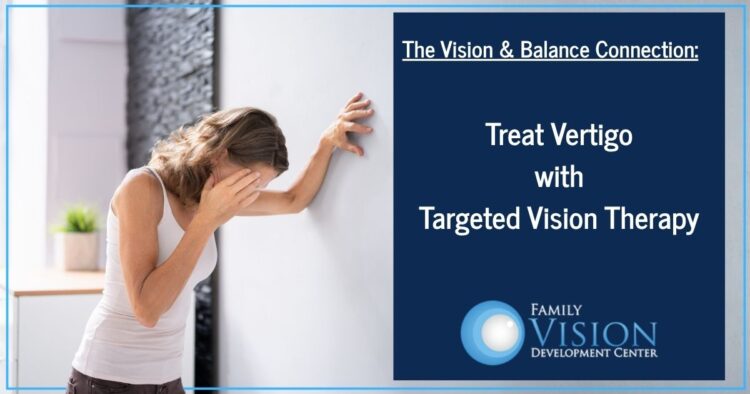
Those who suffer from vertigo are all too familiar with the symptoms – dizziness when moving your head, feeling like the room is spinning, or struggling to maintain balance when standing up. This condition can be extremely frustrating and can have a significant impact on daily life.
Vertigo can be caused by a number of possible factors, including inner ear disorders which are most common. But it can also develop if you have a condition that affects your brain, such as a stroke or head injury. When the eyes and brain do not work together properly, symptoms like dizziness can worsen until the condition is treated.
The Connection Between Vision and Balance
Your ability to stay balanced depends on your brain constantly combining information from three different systems: your eyes, your inner ear, and the muscles and joints throughout your body. Your eyes tell your brain where you are in relation to your surroundings, your inner ear senses movement and changes in head position, and your muscles and joints provide feedback about your body’s position.
When all three systems work together, your brain can accurately determine where you are in space, helping you move confidently and maintain your balance. But if your visual system isn’t communicating properly with the rest of your body, those mixed signals can cause your brain to become confused, leading to symptoms such as dizziness, vertigo, motion sensitivity, poor balance, headaches, or nausea.
Vision Issues that Contribute to Vertigo
When the visual system is not functioning properly, it can lead to vertigo. Someone who has trouble tracking or focusing on a moving object, has poor eye teaming skills, has issues with controlling eye movement, or suffers from a binocular vision disorder can suffer from frequent dizziness.
Using Vision Therapy to Treat Vertigo
Vision therapy is a personalized program of visual exercises designed to improve how your eyes and brain work together. Unlike simply prescribing glasses, vision therapy works to strengthen this communication between your eyes and your brain, with treatment customized based on each patient’s specific visual challenges and symptoms.
It can be an effective option for treating vertigo, as it focuses on improving poor visual skills that often lead to dizziness, such as:
- Eye coordination
- Eye tracking
- Ability to focus
- Depth perception
- Visual processing
- Balance-related visual skills
Working with Family Vision Development Center for Effective Vision Therapy
At Family Vision Development Center, we have extensive training in vision therapy and can provide custom treatment plans that target the specific visual skills needed to improve feelings of dizziness. Our knowledge extends to those who have experienced a concussion or traumatic brain injury, stroke or neurological injury, prolonged illness or other neurological conditions – all of which can lead to symptoms of vertigo. If you are experiencing dizziness and have not been able to find relief, we encourage you to visit us for a consultation to see if a vision therapy program might be the right option for you. Contact us at 630-862-2020 to learn more.
Family Vision Development Center is a full-service vision center offering innovative vision therapy services, sports vision therapy services, post-concussive vision rehabilitation, comprehensive vision exams for eyeglasses and contact lenses, management of ocular diseases including glaucoma, diabetes, macular degeneration and cataracts, and a state-of-the-art optical center offering the latest designs in eyewear. We are dedicated to keeping our patients comfortable and well-informed and we will explain every exam and procedure and answer all of your questions. We accept both scheduled and emergency appointments, and offer convenient financing and insurance options to ensure that high-quality vision care is available and affordable to all of our patients.
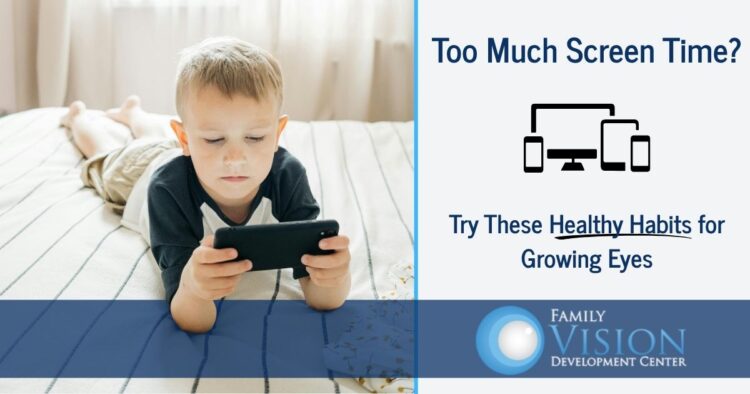
It’s summertime and the kids are getting a nice break from school. But, that free time unfortunately often leads to excessive screen time. If they are wasting their time staring at a phone screen instead of spending quality time outdoors or with friends, it can have a lasting effect – not just on their social skills, but also on their vision.
The Effect of Screen Time on Vision
When a child uses a digital device, they are often focusing on images that are close up for an extended period of time. This constant concentration can put added stress on the eyes and can lead to a condition known as digital eye strain. Some common symptoms of digital eye strain include:
- Tired or sore eyes
- Blurry vision
- Frequent headaches
- Dry or watery eyes
- Difficulty focusing
The Link Between Digital Screen Time and Nearsightedness
In addition to the symptoms provided above, there is an even bigger concern for kids using digital devices. Excessive screen time, combined with less time outdoors in the natural sunlight, can have detrimental effects. In fact, kids that spend even one hour per on day on a digital screen see an increased risk of developing myopia, or nearsightedness. And, that risk continues to rise with each additional hour of screen time.
It is not always avoidable, especially with the rise in screen use in the classroom, but parents that limit screen time during the summer months can help protect their child’s vision now, as well as decrease the risk of developing serious eye conditions that are linked to myopia later in life.
Healthy Habits for Screen Time
Some screen time is necessary, and is to be expected even during summer. But luckily, there are some ways to minimize the negative effects of digital screens.
- Every 20 minutes, make sure to look at something that is at least 20 feet away for 20 seconds. This is appropriately called the 20-20-20 rule, and it helps the focusing muscles in the eyes relax.
- Keep phones and tablets about 18 inches away from your eyes, and keep computer monitors about an arm’s length away in order to maintain a healthy viewing distance.
- Avoid digital screens before bedtime, as blue light can affect the quality of sleep as well as eye comfort.
- Blinking is essential because it spreads tears across the surface of the eyes, keeping them from becoming dry and irritated, and reducing burning, redness and blurry vision.
Maintain your Child’s Healthy Vision at Family Vision Development Center
Regular visits for comprehensive eye exams with our team can go a long way in protecting your child’s vision now and into the future. Vision exams allow us to fully evaluate the way your child’s eyes work together as a team, along with their focusing ability and overall eye health. With regular visits, we can quickly determine when a new issue arises, which allows us to more effectively treat any problems that may interfere with their daily activities, such as school, sports or social interactions. Contact us today at 630-862-2020 to learn more about our practice or to schedule an appointment.
Family Vision Development Center is a full-service vision center offering innovative vision therapy services, sports vision therapy services, post-concussive vision rehabilitation, comprehensive vision exams for eyeglasses and contact lenses, management of ocular diseases including glaucoma, diabetes, macular degeneration and cataracts, and a state-of-the-art optical center offering the latest designs in eyewear. We are dedicated to keeping our patients comfortable and well-informed and we will explain every exam and procedure and answer all of your questions. We accept both scheduled and emergency appointments, and offer convenient financing and insurance options to ensure that high-quality vision care is available and affordable to all of our patients.
For many athletes, summer is a time to prepare for the next season, often focusing on strength training, conditioning, and skill development. But for athletes recovering from a concussion, eye injury, or a disappointing season, summer can also be an opportunity to rebuild something that is often overlooked: visual performance.
The ability to track a moving ball, react quickly to changing situations, judge distances accurately, and maintain awareness of surrounding players all depend on visual skills. After an injury, or even an extended period away from competition, those skills may not be functioning at their best. Sports vision therapy and neuro-optometric rehabilitation can help athletes restore and strengthen the visual skills that are needed for both performance and safety, giving them greater confidence as they return to competition.
An Injury Can Impact Visual Skills
Many athletes assume that once their symptoms are gone, they are ready to return to play. Unfortunately, injuries like concussions can affect the complex connection between the eyes and the brain long after obvious symptoms fade. Common visual problems that may develop after a concussion or injury include:
- Difficulty tracking moving objects
- Delayed reaction times
- Problems with eye teaming and focusing
- Reduced peripheral awareness
- Double vision or blurred vision
- Trouble judging distances accurately
- Difficulty processing visual information quickly
These challenges can make an athlete feel slower, less confident, or less coordinated than they were before the injury. In some cases, athletes may not even realize that visual problems are contributing to their struggles. They simply know that something feels different, or off, when they return to practice or competition.
What Is Sports Vision Therapy?
Sports vision therapy is a customized program designed to improve the visual skills that support athletic performance. Unlike a standard eye exam, vision therapy focuses on how effectively the eyes and brain work together to process visual information. Depending on the athlete’s needs, therapy may target:
- Eye tracking
- Visual processing speed
- Dynamic focusing abilities
- Depth perception
- Eye-hand coordination
- Visual reaction time
- Peripheral awareness
- Balance and visual-motor integration
These skills are essential for strong performance in most sports, from baseball and softball to soccer, football, basketball, hockey, and tennis.
Neuro-Optometric Rehabilitation After Concussion
For athletes recovering from concussions or other brain injuries, neuro-optometric rehabilitation offers an additional layer of support. This specialized form of therapy focuses on restoring visual skills that may have been affected by an injury. Because the visual system involves multiple areas of the brain, even a mild concussion can create challenges that can affect athletic performance and daily activities. Neuro-optometric rehabilitation may help athletes improve:
- Visual comfort
- Balance and spatial awareness
- Tracking and focusing abilities
- Processing speed
- Coordination between vision and movement
By addressing these needs directly, it can make it easier for an athlete to successfully return to play.
Summer is a Great Time for Athletes to Get Started
The weeks leading up to a new season can be a valuable time to prepare. Rather than waiting until problems appear during competition, athletes can use the offseason to strengthen their visual skills, address lingering effects of an injury, and rebuild their confidence. Whether an athlete is returning from a concussion, recovering from an eye injury, or looking to improve their skills after a challenging season, sports vision therapy and neuro-optometric rehabilitation can provide a structured path forward.
We Help Athletes Improve Performance
At Family Vision Development Center, we have extensive training in both sports vision therapy and neuro-optometric rehabilitation so we can meet the needs of any athlete looking to sharpen their skills and improve their performance in the game. We work closely with athletes who are recovering from injury to restore essential visual acuity, as well as those who want to gain a competitive edge over the competition. Reach out to our team to learn more by calling 630-862-2020.
Family Vision Development Center is a full-service vision center offering innovative vision therapy services, sports vision therapy services, post-concussive vision rehabilitation, comprehensive vision exams for eyeglasses and contact lenses, management of ocular diseases including glaucoma, diabetes, macular degeneration and cataracts, and a state-of-the-art optical center offering the latest designs in eyewear.
Summer vacation is a time for outdoor adventures, road trips, beach days and family fun. While many people remember to pack sunscreen and stay hydrated, they often overlook important eye protection. Unfortunately, when your eyes are exposed to sunlight, water, wind, and outdoor activities, your vision can be at risk if you don’t take the right precautions. Whatever your plans are this summer, following a few simple tips can help to protect your vision while away from home.
Always Wear Sunglasses
One of the most important ways to protect your eyes while on summer vacation is to wear quality sunglasses. The sun’s ultraviolet (UV) rays can damage the eyes, and extended exposure can cause conditions such as cataracts, growths on the eye, macular degeneration, sunburn of the eyes and even some types of cancer. Always look for sunglasses that block 100% of both UVA and UVB rays.
A Wide-Brimmed Hat Can Offer Extra Protection
Sunglasses are essential, but when you wear them along with a wide-brimmed hat, they become even more effective. A wide-brimmed hat can significantly reduce the amount of UV rays and glare that reach your eyes. This extra layer of protection is especially helpful when at the beach, on a boat, taking a tour, hiking or enjoying outdoor sporting events.
Protect your Eyes Around Water
Many people don’t realize how much water reflects sunlight, which increases UV exposure and glare to the eyes. Polarized sunglasses can help reduce the glare and eye strain around pools, lakes or oceans. If you wear contact lenses, try to avoid wearing them in the water whenever possible, as the lenses can absorb contaminated water and trap harmful chemicals or germs against the eyes.
Staying Hydrated can Keep your Eyes More Comfortable
Intense summer heat can lead to dehydration, which may make dry eye symptoms worse. When your body gets dehydrated, it can make your eyes feel dry, irritated, gritty or fatigued. Summer vacation often means extended periods of time outdoors, so drinking plenty of water throughout the day helps support healthy tear production and overall eye comfort.
Keep Chlorine and Salt Water Out of your Eyes
Swimming pools and ocean water can irritate the eyes. Chlorine may strip away the natural tear film that protects the eye’s surface, while salt water can cause stinging and discomfort. Swim goggles can help protect your eyes from irritation, bacteria and other contaminants. If your eyes become irritated after swimming, rinse them with clean water or lubricating eye drops.
Wear Protective Eyewear During Summer Activities
Summer vacation is often filled with activities that can increase the risk of eye injuries. Sports such as baseball, tennis, pickleball and even cycling can pose hazards to your vision. Protective eyewear can help prevent injuries caused by balls and other sports equipment, flying debris, collisions or dust and dirt.
Give your Eyes a Break During Road Trips
Road trips during summer vacation often mean long hours behind the wheel, which can cause eye fatigue, especially when staring at the road for extended periods of time. Try to reduce eye strain by taking regular breaks from driving, blinking frequently, wearing sunglasses to reduce glare, and using artificial tears of your eyes get too dry.
Be Aware of Too Much Air Conditioning
Air conditioning keeps us comfortable when the temperatures rise, but too much can affect your eyes. The constant flow of air conditioning in a hotel room, airplane or car can cause the moisture on the surface of the eye to evaporate more quickly, which causes dry eyes. Turing down the A/C, using lubricating drops and staying hydrated can all help keep your eyes comfortable.
Schedule an Eye Exam Before Your Summer Vacation
If you are planning a big trip, consider scheduling an eye exam beforehand so we can ensure your prescription is current and identify any issues that may affect your comfort or safety while traveling. During your exam, we can also discuss concerns such as contact lens care, avoiding dry eyes, UV protection or vision changes.
The team at Family Vision Development Center is here to take care of any issues before your trip, so you can enjoy your vacation more while keeping your eyes protected and comfortable. Contact us to schedule an appointment by calling 630-862-2020.
Family Vision Development Center is a full-service vision center offering innovative vision therapy services, sports vision therapy services, post-concussive vision rehabilitation, comprehensive vision exams for eyeglasses and contact lenses, management of ocular diseases including glaucoma, diabetes, macular degeneration and cataracts, and a state-of-the-art optical center offering the latest designs in eyewear.
Vision exams are far more interesting, and definitely more important, than most people realize. They are not simply a means to ensure a proper prescription for your glasses, but rather they provide a wealth of information concerning your vision and even your overall health. Here are some interesting facts that will probably make you view your appointment differently.
Vision Exam Facts You Probably Didn’t Know
- Eye Exams Include Tests You Might Not Notice – you may think you are just reading letters on a chart, but we are also evaluating your eye movement, coordination and ability to focus in order to ensure that they are working together properly.
- You Don’t Need Symptoms to Have a Vision Issue – many vision problems develop gradually over time, and symptoms are not always noticeable. Conditions like glaucoma or macular degeneration often progress without any warning signs, which is why regular vision exams are so important even if your eyesight seems fine.
- Vision Exams Can Reveal Dangerous Health Problems – during an eye exam, we are often able to detect signs of systemic health conditions like high blood pressure, diabetes, high cholesterol and even certain autoimmune disorders by examining the blood vessels and structures in your eyes.
- Digital Eye Strain Has Become a Very Common Complaint – digital screens are a huge part of daily life and that means more people are experiencing the effects of digital eye strain such as dryness, headaches and blurred vision. If we detect signs of eye strain during the vision exam, we can recommend solutions to ease the discomfort and prevent further symptoms.
- Contact Lens Exams Are Different From Standard Vision Exams – if you wear contact lenses, your exam includes additional measurements to ensure proper fit and eye health. Contacts that don’t fit properly can lead to discomfort and even long-term damage if not addressed.
- Children’s Vision Exams are Important for Learning – vision plays a major role in how children learn. When a child has a vision issue, it can affect reading, attention, and performance in school. Regular vision exams, starting at a young age, can help identify and correct problems early on, increasing their chance for classroom success.
- You Can Have 20/20 Vision and Still Have Eye Issues – 20/20 vision is only a measure of visual acuity, which is the sharpness or clarity of sight at a specific distance. But someone who can see clearly can still have problems with depth perception, peripheral vision, coordination or overall eye health.
- Eye Pressure Tests Help Detect Glaucoma – the quick puff of air measures intraocular pressure, which is key in detecting glaucoma. Since glaucoma often has no early symptoms, this part of the exam is essential for protecting long-term vision.
- Dilated Eye Exams Provide a More Detailed Look – when your eyes are dilated, we get a much clearer view of the retina and optic nerve. This allows us to look for possibly serious conditions that we might not notice otherwise.
- Eye Health and Overall Health Are Closely Connected – changes in your eyes can sometimes be an early indicator of other health concerns. When you visit us for regular vision exams, we are able to proactively monitor these changes over time.
Regular Vision Exams are an Essential Part of your Overall Healthcare
Routine vision exams are one of the easiest ways to protect both your eyesight and your overall health. Many eye conditions develop without warning signs, so waiting until something feels wrong can mean missing the early stages when treatment is most effective. Regular visits allow us to track subtle changes, update your prescription as needed, and catch potential problems before they progress. Whether you wear glasses, contacts, or have never needed vision correction, staying consistent with your eye exams is a proactive step toward long-term wellness. Reach out to the Family Vision Development Center team at 630-862-2020 with questions or to schedule your appointment.
Family Vision Development Center is a full-service vision center offering innovative vision therapy services, sports vision therapy services, post-concussive vision rehabilitation, comprehensive vision exams for eyeglasses and contact lenses, management of ocular diseases including glaucoma, diabetes, macular degeneration and cataracts, and a state-of-the-art optical center offering the latest designs in eyewear.
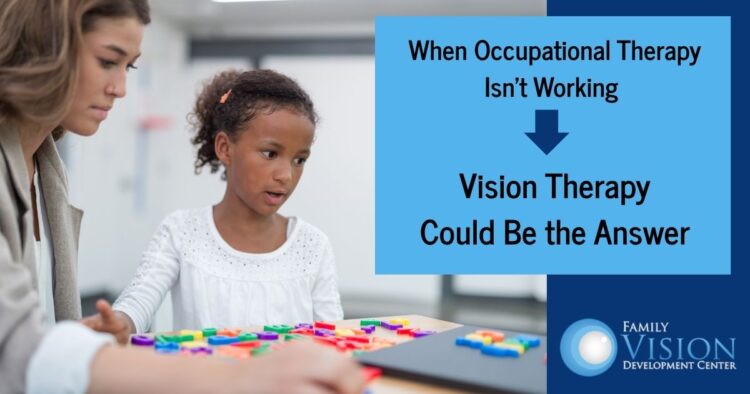
An occupational therapist can play an important role in helping a child build the skills they need to succeed in daily life. They work with kids to develop essential skills like handwriting, proper coordination, attention and taking care of themselves. But if a child is still struggling, even after consistent therapy, there might be another issue interfering – their visual skills.
Vision is more than just seeing clearly. It is actually a complex system that involves the eyes working together as a team and the brain properly processing the visual information it receives. When these systems are not functioning correctly, children may have trouble performing tasks that seem unrelated to eyesight. That’s where a tailored vision therapy program can make a significant difference.
Understanding the Signs of Visual Dysfunction
Children don’t always understand that a vision issue is present, so they don’t know how to communicate what the problem is. Instead, they often simply adapt to their circumstances and they end up compensating in ways that further complicate their developmental progress. When an occupational therapist works with a child over a period of time, they are able to observe certain patterns and signs that vision therapy could be necessary. Some common signs that may indicate a need for a vision therapy evaluation include:
- Poor eye-hand coordination, such as difficulty catching a ball, completing puzzles, or using utensils
- Avoiding close-up tasks like coloring, reading, or writing
- Frequently losing their place when reading or copying from a board
- Reversing letters or numbers
- Excessive head movement or closing one eye when focusing
- Short attention span during tasks that require visual concentration
- Frequent headaches, eye strain, or fatigue
- Difficulty with coordinating both sides of the body
These challenges may be the result of issues like poor eye teaming (binocular vision), inaccurate eye movements (tracking), or difficulty focusing (accommodation).
How Vision Therapy Supports the Goals of an Occupational Therapist
When a child’s visual skills are not developed properly, they may not be able to fully benefit from working with their occupational therapist. For example, a child’s difficulty with their handwriting sessions might not be due to a weakness in fine motor skills. Instead, it could be because their eyes cannot efficiently track across a page or maintain focus.
Vision therapy is a personalized program designed to improve visual function and processing. It targets skills such as:
- Eye teaming and alignment
- Tracking and visual scanning
- Focusing flexibility
- Visual memory and processing speed
By addressing these foundational skills, vision therapy can make it easier for a child to participate in OT and make more consistent progress.
Collaboration Leads to Better Outcomes
Occupational therapists and optometrists share a common goal – helping children succeed in their daily environments. When these providers work together with a unified treatment plan, children benefit from a more comprehensive, whole-child approach.
The team at Family Vision Development Center has extensive training and experience in vision therapy treatment. We work with each child to create an individualized plan that targets their specific visual challenges, so they get the most benefit from their work with their occupational therapist. The earlier we can identify issues and get to work with the right therapy, the quicker we can help prevent a child’s frustration, improve their confidence and support their long-term success, both in and out of therapy. Contact us at 630-862-2020 to learn more.
Family Vision Development Center is a full-service vision center offering innovative vision therapy services, sports vision therapy services, post-concussive vision rehabilitation, comprehensive vision exams for eyeglasses and contact lenses, management of ocular diseases including glaucoma, diabetes, macular degeneration and cataracts, and a state-of-the-art optical center offering the latest designs in eyewear.